AI Maturity in the Zero-Click Future: Why Companies Need More Than Just Visibility

Authored by

June 17, 2026
How AI-ready is your customer journey—when your customers ask ChatGPT before they ask you?
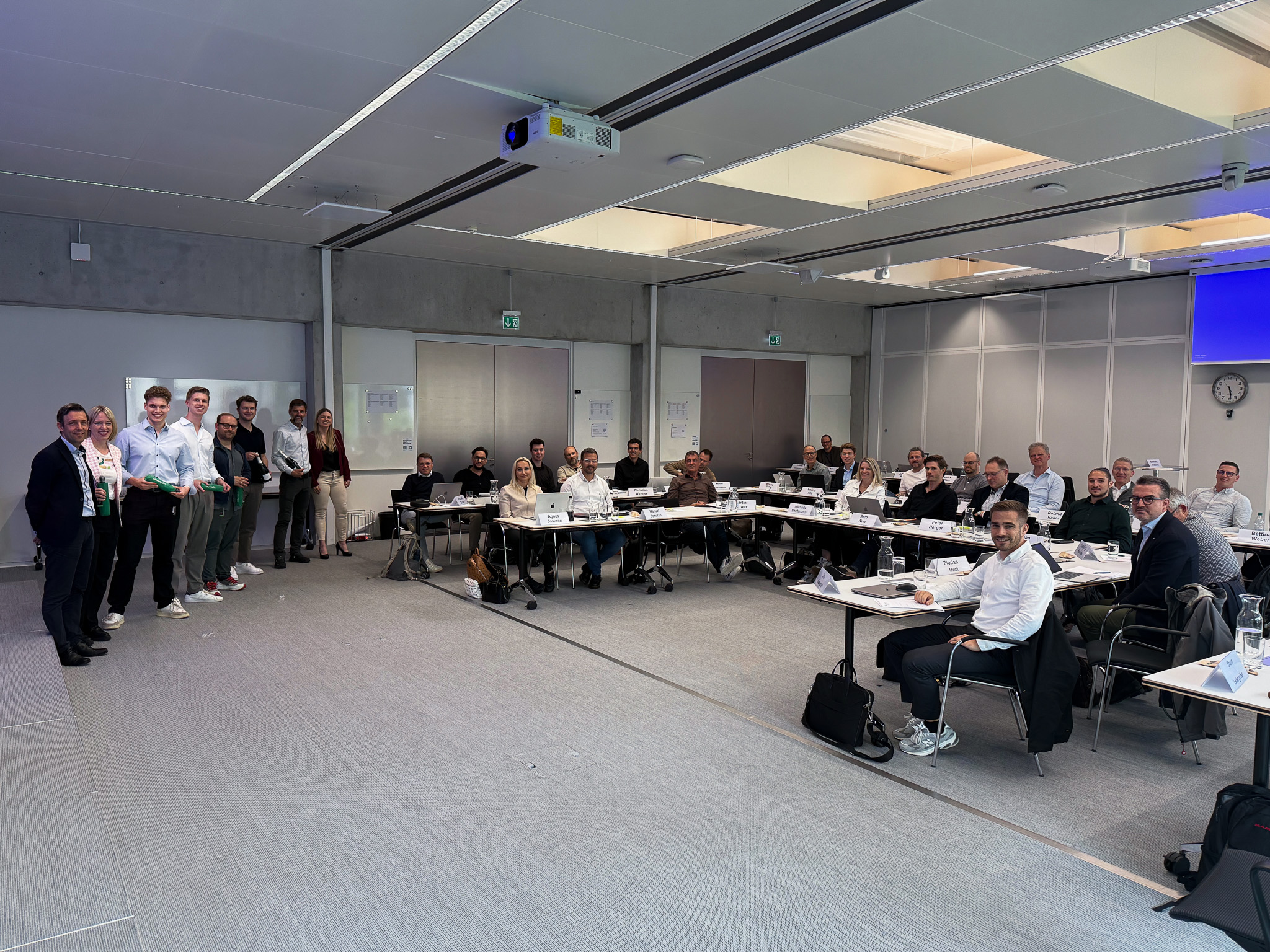
This question was the focus of our workshop at KMUmeetHSG at the University of St. Gallen. We were invited by KMU-HSG Connect to speak with decision-makers from Swiss SMEs about a trend that many companies are only just beginning to notice: Customers, partners, and talent no longer search exclusively on Google. They turn to AI systems.
ChatGPT. Claude. Gemini. Perplexity. Claude. Google AI Overviews.
This isn't just changing marketing. It's changing the way companies are discovered, compared, evaluated, and selected.
And that is precisely why the so-called “zero-click” future is not just an isolated SEO issue. It is a concrete example of why AI maturity must be measured in a more holistic way today.
The customer journey is partly guided by AI systems
In the past, digital visibility was organized in a relatively clear-cut way.
A potential customer searched on Google, clicked on several websites, compared providers, read reviews, and then made a decision. Companies were able to influence this journey relatively directly through website structure, SEO, landing pages, case studies, and conversion optimization.
Today, a new logic is emerging.
Users ask AI systems complete questions:
- "Which provider is right for my problem?"
- "Which company has experience in my industry?"
- "Which solution is right for a Swiss SME?"
- "Which providers are trustworthy?"
- "What alternatives are there to Provider X?"
The answer is no longer a list of ten blue links. It consists of a direct recommendation, a summary, or a shortlist.
That is the essence of zero-click search: Users receive relevant information without necessarily having to click on a website.
For companies, this means that their own websites remain important. But their role is changing. They are no longer just digital brochures for people, but increasingly serve as a data source for AI systems.
Why this is a topic on the AI Maturität exam
Many companies still have a narrow understanding of AI maturity.
You ask:
- Do our employees use ChatGPT?
- Have we launched our first AI pilots?
- Are there any internal automation processes?
- Do we have an AI policy?
- What tools are we already using?
These questions are important. But they are no longer enough.
After all, AI doesn't just change internal processes. It also changes how companies are perceived, found, compared, and evaluated externally. The customer journey is increasingly shaped by AI systems.
This means that a company may already be using AI tools internally but still be strategically blind if it does not understand how AI affects its market position, customer acquisition, visibility, and competitiveness.
Modern AI maturity must therefore combine two perspectives:
Inside-out:
How well is the company positioned internally for AI—in terms of data, systems, strategy, culture, skills, governance, and security?
Outside-in:
How is the company perceived from the outside—by markets, talent, customers, competitors, and, increasingly, by AI systems?
It is precisely this connection that is crucial.
What We Demonstrated at KMUmeetHSG
In the workshop, we analyzed the trend based on current market signals.
The key observation: AI chatbots and AI agents are increasingly taking over search and decision-making functions. The data presented shows that ChatGPT prompts rose significantly during the period under review, while traditional Google searches declined in comparison. In addition, forecasts were discussed suggesting that traditional search volume and organic website traffic could come under pressure, while zero-click searches driven by AI responses are on the rise.
But even more important than individual figures is the direction:
The focus of the search is shifting from lists of links to answers.
And this change doesn't just affect B2C. It also affects B2B and SMEs.
An architect can ask AI to recommend suitable facade contractors. An HR manager can ask AI to recommend suitable outsourcing partners. A CEO can ask AI to recommend restructuring experts. A procurement manager can ask AI to recommend specialized suppliers.
The question is then no longer just:
"Do we rank on Google?"
Rather:
"Are we correctly understood, categorized, and recommended as a relevant solution by AI systems?"
GEO: A new building block, but not the entire strategy
A term that is becoming increasingly important in this context is GEO — Generative Engine Optimization.
GEO describes the optimization of content, data, and digital trust signals so that companies are visible, correctly understood, and cited or recommended as relevant sources in AI-powered responses.
Simply put:
SEO helps companies get found in search engines.
GEO helps companies appear in AI responses.
But GEO doesn't replace SEO. GEO builds on SEO.
The fundamentals of classical music remain important:
- a clean, technical website structure,
- indexable pages,
- fast loading times,
- relevant content,
- clear headings,
- good internal linking,
- structured data,
- External reputation.
A new question has arisen: Can AI systems interpret a company's content in a way that is machine-readable, unambiguous, and trustworthy?
The New Metrics Question: Not Just Traffic, but “Share of Answer”
In the world of traditional SEO, metrics such as rankings, impressions, clicks, and organic traffic were tracked.
An AI-powered search raises new questions:
- Is our company mentioned in AI responses?
- Is it described correctly?
- Which competitors are emerging instead?
- What sources does the AI system use?
- What information is missing?
- What external signals strengthen or weaken our position?
An important new metric is the “Share of Answer.” This refers to how frequently and prominently a company appears in AI-generated responses.
This isn't just relevant to marketing. It becomes a strategic signal.
After all, if AI systems increasingly influence which vendors make it onto a shortlist, then AI visibility becomes a measure of a company’s maturity.
The Gap: Relevance Recognized, Implementation Barely Begun
During the workshop, we also presented the initial findings of an ongoing study on AI-powered search.
The trend is clear:
Many companies recognize that digital visibility is changing. At the same time, only a few have taken concrete steps so far.
In the results presented, 76% of the companies surveyed stated that they intend to align their websites with AI systems over the next five years. At the same time, only 6% said they are already actively implementing measures to improve AI visibility.
What’s particularly interesting is that the majority does not expect the future of websites to be either purely human or purely machine-driven. 77% of respondents see the website of the future as a hybrid—that is, optimized for both humans and AI systems.
This shows that companies know things are changing. What’s often missing is a structured way to assess their current status and determine the right next steps.
Why Companies Without Measurability Are Flying Blind
The problem isn't that companies aren't familiar enough with AI tools.
The problem is that many companies don't know where they really stand.
They're launching pilot projects. They're testing ChatGPT. They're building internal automation systems. They're discussing governance. They might even be creating their first AI roadmaps.
But often there is no objective basis:
- How mature is our data foundation?
- How clear is our AI strategy?
- How strong is our technical foundation?
- How well are employees empowered?
- How secure and compliant is our use of the service?
- How do we compare to similar companies?
- Which initiatives are truly a priority?
- What external signals indicate whether the market already perceives us as AI-ready?
Without this foundation, strategic blindness sets in.
And that's exactly where CorpIn comes in.
CorpIn: The Platform for AI Maturity
With the CorpIn platform, we make AI maturity measurable, comparable, and manageable.
We do not view AI maturity as a subjective gut feeling or a one-time consulting report. We view it as a structured, data-driven management system for leadership teams.
The platform connects:
- internal organizational data,
- Self-assessments,
- external market signals,
- Benchmarking against comparable companies,
- prioritized recommendations for action,
- Measuring progress over time.
The goal is not to provide yet another AI tool.
The goal is to create a new strategic management level: a corporate intelligence layer that helps companies make AI-driven decisions based on facts rather than assumptions.
From Fragmented AI Initiatives to Strategic Clarity
Many companies are currently in a phase where AI initiatives are growing rapidly but are not yet being adequately managed.
Typical patterns include:
- Individual departments are testing different tools,
- Employees use AI informally,
- Data is scattered across various systems,
- Strategic priorities are unclear,
- Governance is established after the fact,
- The ROI of AI initiatives remains difficult to measure.
This leads to a paradoxical situation: Companies are doing a lot, but often don't know whether these efforts are actually helping them mature.
CorpIn provides an objective basis here.
The platform helps leadership teams answer key questions:
Where do we stand?
A structured AI Maturity Score shows how mature the company is across key dimensions.
How do we stack up against the competition?
Benchmarking allows us to compare ourselves with relevant peers by industry, company size, or market environment.
What should we do next?
Prioritized recommendations highlight which areas of action offer the greatest strategic leverage.
How does our organization evolve over time?
Progress becomes continuously measurable, rather than being visible only sporadically in workshops or reports.
Why External Signals Are Becoming Increasingly Important
A key takeaway from our workshop: AI maturity doesn't stop at the company's boundaries.
External signals are becoming increasingly important because AI systems use public information to categorize companies. These include, for example:
- Website content,
- Job listings,
- public AI activities,
- Technology stacks,
- Media mentions,
- Industry Profiles,
- Customer reviews,
- Partner sites,
- Technical articles,
- structured data.
These signals do not tell the whole story about a company. But they influence how a company is perceived by markets, customers, and AI systems.
That is why CorpIn incorporates external signals as well as internal assessments into its evaluation of AI maturity.
Not to reduce companies to mere marketing visibility, but to create a more complete picture of their organizational sustainability.
What Companies Should Do Specifically Right Now
The "zero-click" future is a prime example of how quickly AI is impacting existing business processes. Companies should therefore not wait until the full impact becomes apparent.
A pragmatic first step consists of five questions:
1. Which decisions are already being prepared by AI for our customers?
Many customers use AI not only to write text, but also to research, shortlist, and evaluate providers.
2. What questions do customers ask AI systems before they speak with us?
These prompts mark the new early stage of the customer journey.
3. Are we being understood correctly in these answers?
It's not enough to be mentioned somewhere. What matters is whether the description is accurate, relevant, and trustworthy.
4. What internal capabilities are lacking to strategically manage this development?
These include data, systems, expertise, governance, culture, and clear lines of responsibility.
5. How do we measure progress?
Without measurement, AI maturity remains subjective. Companies need scores, benchmarks, and clear priorities.
The Difference Between Short-Sighted Action and True AI Maturity
Many companies are responding to AI with speed. That's understandable.
But speed without measurability often leads to knee-jerk reactions.
True AI maturity only emerges when companies understand:
- what skills are available,
- what gaps exist,
- which initiatives create value,
- how they compare to their peers,
- what risks arise,
- and which next steps should be prioritized.
That's exactly what CorpIn was developed for.
Conclusion: The future belongs to companies that can be measured
The zero-click future is just one visible symptom of a larger trend.
AI is becoming an intermediary between companies and the market. It influences how customers search, how providers are compared, how talent evaluates employers, and how leadership teams prepare decisions.
Therefore, companies must do more than just use AI. They must understand how AI is changing their organization, their market position, and their decision-making capabilities.
That is the essence of modern AI maturity.
And that's exactly what we're working on with CorpIn.
CorpIn makes AI maturity measurable, benchmarkable, and manageable—so that companies no longer have to make decisions about AI blindly.
Start Your AI Maturity Assessment
Would you like to know where your company stands in terms of AI maturity?
With the CorpIn platform, you can launch your AI Maturity Assessment, evaluate your organization in a structured way, and identify initial areas for action.
Create a free account now and start the assessment:
www.corpin.ch
CorpIn – Defining Corporate Intelligence.
FAQ
What is AI maturity?
AI maturity describes how well a company is able to leverage artificial intelligence in a meaningful way from strategic, technical, organizational, and cultural perspectives. This includes, among other things, data quality, technical infrastructure, governance, strategy, employee expertise, security, and measurable business impact.
What is Zero-Click Search?
Zero-Click Search refers to search behavior in which users receive an answer directly from a search engine or AI system without having to click on a website. In the age of AI, this increasingly applies to answers from ChatGPT, Gemini, Perplexity, or Google AI Overviews.
Why is zero-click search a part of AI maturity?
Zero-Click Search shows that AI is transforming not only internal processes but also external market interactions. When customers consult AI systems before contacting a company, the ability to be correctly understood and categorized by AI systems becomes a key aspect of modern AI maturity.
What does GEO stand for?
GEO stands for Generative Engine Optimization. It refers to the optimization of content, data, and digital trust signals so that companies are visible, correctly understood, and cited as relevant sources in AI-generated responses.
Does GEO replace traditional SEO?
No. GEO builds on SEO. Technical accuracy, indexable content, good structure, relevant content, and external reputation remain important. A new factor is whether AI systems can understand content, summarize it, and use it effectively in their responses.
What does the CorpIn platform measure?
The CorpIn platform measures AI maturity through structured assessments, internal capabilities, external signals, and benchmarks. The goal is to provide companies with an objective basis for decision-making: Where do we stand? How do we compare to others? Which next steps should be prioritized?
Who is CorpIn relevant for?
CorpIn is aimed at leadership teams, CEOs, boards, and decision-makers at medium-sized and larger companies who want to do more than just experiment with AI—they want to make it strategically measurable, comparable, and controllable.
Why is benchmarking needed for AI maturity?
Without benchmarking, a company assesses its AI maturity solely from its own perspective. Comparing itself to similar companies helps it set priorities more realistically, better justify investments, and avoid strategic blind spots.
How can a company get started?
The easiest way to get started is with a structured AI Maturity Assessment. This process highlights existing strengths, identifies gaps, and determines which areas of focus should be addressed first. With CorpIn, you can get started by creating a free account at www.corpin.ch.
The content of this article may have been improved with the help of artificial intelligence. Therefore, we cannot guarantee that all information is complete and error-free.