The Hybrid Era Is Here: Why AI Governance Alone Is No Longer Enough

Verfasst durch
October 21, 2026
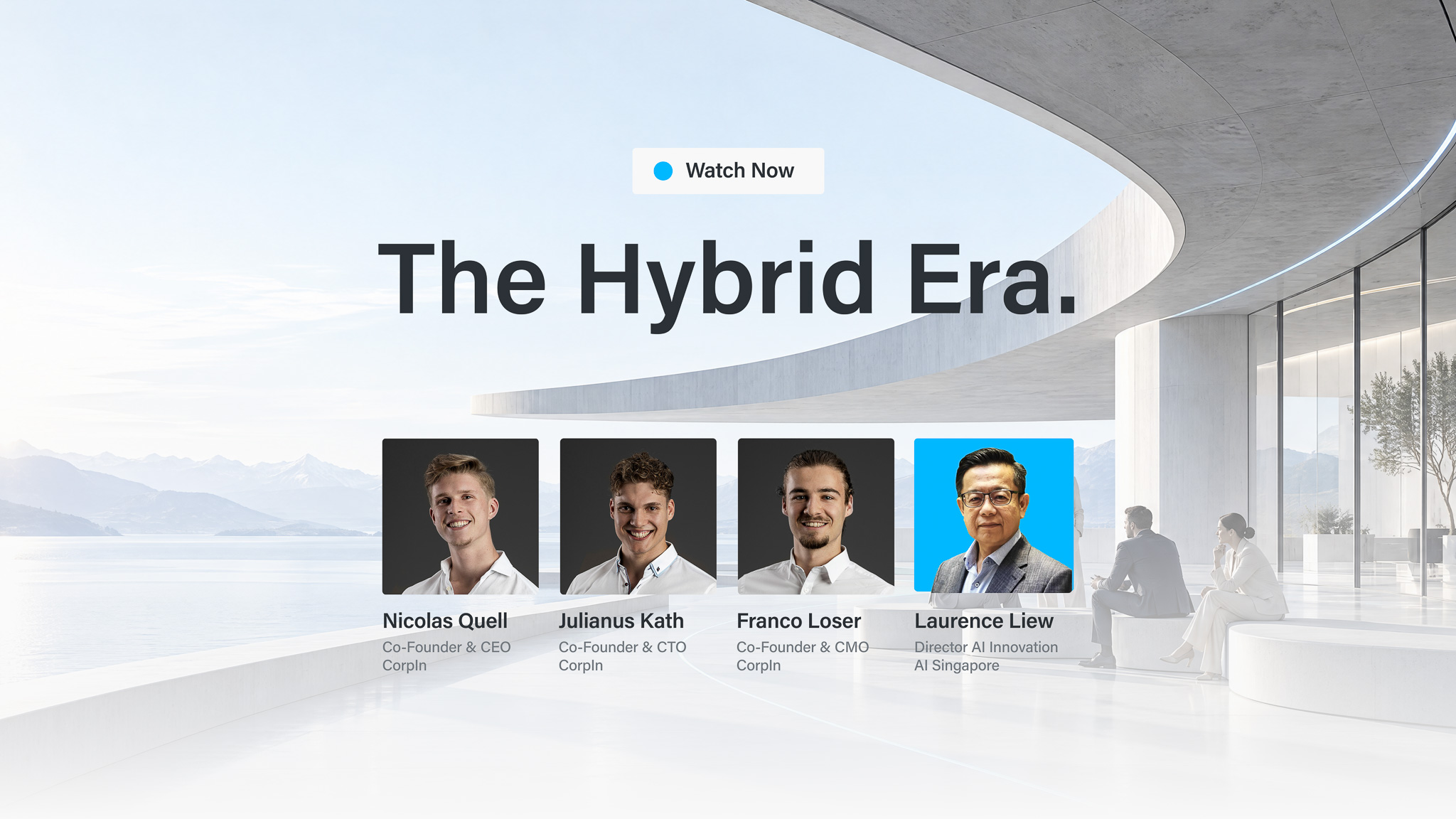
New research presented at CorpIn Horizon 2026 reveals a critical gap between AI adoption and measurable business value. With special guest Laurence Liew from AI Singapore, we explored what the Hybrid Era means for the future of AI Governance, AI Maturity and enterprise transformation.
Artificial intelligence is entering a new chapter. AI systems are evolving from helpful assistants into autonomous agents that can execute tasks, coordinate workflows and increasingly work alongside humans.
But while AI capabilities are advancing rapidly, one fundamental question remains: Are organisations actually becoming better at using AI — and can they prove the value it creates?
On 21 October 2026, we explored exactly this question at CorpIn Horizon 2026: The Hybrid Era – Rethinking AI Governance. The event attracted more than 100 registrations from over 17 countries across four continents, bringing together executives, researchers and AI leaders.
Missed the event? Watch the full webinar recording on YouTube.
Only 13% Have Clear Visibility Into Their AI ROI
One of the most striking findings from our latest research highlights a challenge facing organisations as AI adoption accelerates.
Only 13% of the organisations surveyed reported having a clear overview of the ROI and measurable business impact of their AI applications.
Companies are investing in new AI tools, launching pilots and introducing autonomous agents. Yet understanding whether these investments generate meaningful returns remains difficult.
During our qualitative research with C-level executives and AI leaders, we repeatedly encountered the same concern: organisations are no longer struggling to identify potential AI applications. They are struggling to determine which applications create genuine business value — and how to scale them.
As one banking executive described it, years of AI experimentation had created a growing collection of proofs of concept, while the fundamental question of impact remained unanswered.
The implication is significant.
AI adoption is not the same as AI maturity.
Having hundreds of AI users, dozens of agents or an extensive inventory of applications does not automatically translate into measurable business outcomes.
For leaders, the challenge is shifting from simply knowing where AI is being used to understanding what it achieves, what it costs and where further investment makes sense.
The Hybrid Era: From AI Assistants to Autonomous Teammates
A central theme of the webinar was the transition towards increasingly autonomous AI systems.
We call this The Hybrid Era: an emerging operating reality in which humans, established enterprise systems and autonomous AI agents work together to execute business processes.
And the expectations are already changing.
When asked how work might be distributed in five years, respondents to our forward-looking research question anticipated:
- 36% human-led work
- 42% hybrid human–AI work
- 22% agent-led work
These figures reflect participants' expectations, not a representative forecast of future employment or automation levels. Nevertheless, they illustrate the scale of transformation that business leaders are beginning to anticipate.
As AI agents take on research, analysis, drafting and operational execution, the human role increasingly shifts towards judgment, orchestration, supervision and accountability.
This creates opportunities for productivity and innovation, but also entirely new management responsibilities.
Who controls an agent's access to company data? Who monitors its performance? Who is responsible when something goes wrong? And how can organisations demonstrate that autonomous systems deliver value?
These questions make one thing increasingly clear: AI Governance must evolve alongside AI capabilities.
Three Challenges Enterprises Cannot Ignore
Our executive interviews revealed three recurring concerns that organisations must address.
1. Increasing complexity and costs. New models, platforms, regulations and AI applications are emerging across business units. Maintaining visibility and control becomes more difficult as the technology landscape expands.
2. Employee adoption and organisational learning. Providing AI tools is relatively straightforward. Ensuring that employees use them effectively — and that successful applications spread across departments — is considerably more challenging.
3. Shadow AI and loss of oversight. As employees and AI agents increasingly operate across different systems, organisations need clearer visibility into which technologies are being used, what information they can access and who remains accountable.
Together, these challenges point towards a fundamental shift: AI management can no longer focus exclusively on technology and regulatory compliance. It must increasingly encompass organisational capabilities, strategic priorities and measurable outcomes.
Lessons From Singapore: Why AI Readiness Comes First
A highlight of CorpIn Horizon 2026 was our special guest, Laurence Liew, Director of AI Innovation at AI Singapore.
Drawing on Singapore's experience with enterprise AI adoption, including the 100 Experiments programme and his work on the AI Readiness Index (AIRI), Laurence shared valuable lessons about what makes AI initiatives successful beyond the experimentation stage.
A particularly important principle emerged from his presentation:
Every AI project needs an expected return, a clearly identified owner and a realistic deployment plan.
Without leadership commitment and clear responsibility, promising AI initiatives can remain isolated experiments rather than becoming productive applications.
Singapore's experience demonstrates why organisational readiness matters: the foundations for success must be established before technologies can be deployed and scaled effectively.
But readiness is only the starting point.
Beyond AI Readiness: Introducing Hexagon 2027
At CorpIn, we believe the next step is to move from understanding whether an organisation is ready for AI to evaluating how effectively it actually uses AI.
AI Readiness asks whether an organisation is prepared. AI Maturity asks whether it can generate, demonstrate and sustain value.
During the webinar, we introduced Hexagon 2027, our evolving framework for assessing organisational AI maturity in the Hybrid Era.
The framework considers six interconnected dimensions:
- Strategy: Are AI investments aligned with business priorities?
- Foundations: Can the organisation technically enable and integrate AI?
- Adoption: Is AI effectively embedded in everyday work?
- Compliance: Are applicable requirements understood and implemented?
- Resilience: Can AI systems operate securely, reliably and withstand disruption?
- Value: Does AI generate measurable and sustainable business outcomes?
Governance connects these dimensions through clear accountability, decision rights and ongoing oversight.
The framework reflects an important principle: an organisation with more AI tools or autonomous agents is not necessarily more mature than one with fewer, carefully selected applications.
What matters is whether AI contributes to strategic objectives, operates within appropriate boundaries and produces demonstrable value.
Through CorpIn's evolving AI Maturity Platform, our ambition is to make these capabilities measurable, comparable and actionable — helping leadership teams identify gaps, benchmark progress and prioritise the initiatives that matter most.
Three Priorities for Leaders Entering the Hybrid Era
The webinar concluded with three practical recommendations for organisations navigating this transition.
1. Get the Foundations Right
Understand which AI tools, use cases and agents operate across the organisation. Establish ownership, define expected value and implement governance that enables responsible innovation rather than unnecessarily restricting it.
2. Measure Impact From Day One
Move beyond measuring usage alone. Define meaningful KPIs before implementation and track improvements in productivity, costs, quality, customer experience and other relevant outcomes.
Measurement should inform decisions about what to scale, improve or discontinue.
3. Design the Hybrid Organisation
Rethink workflows around the complementary strengths of humans and AI.
Prepare employees to collaborate with and supervise intelligent systems, establish clear accountability and determine how AI-generated productivity gains can support growth, innovation and better business outcomes.
The objective is not maximum automation. It is better organisational performance.
Watch CorpIn Horizon 2026: The Hybrid Era
The future of AI is no longer simply about adopting new technologies. It is about building organisations capable of managing, measuring and continuously improving how those technologies create value.
AI Governance provides the necessary oversight. AI Maturity turns capability into sustained business value.
We would like to sincerely thank everyone who joined CorpIn Horizon 2026 and especially Laurence Liew for contributing his experience and valuable international perspective.
If you couldn't attend the live event — or would like to revisit the research findings and discussions — the complete recording is available now.
Watch the full webinar: The Hybrid Era – Rethinking AI Governance
Ready to Explore Your Organisation's AI Maturity?
Do you know where your organisation stands, how it compares with peers and which AI initiatives deserve priority?
Discover how CorpIn helps leadership teams move from fragmented AI initiatives to clearer, evidence-based decisions.
Explore the CorpIn AI Maturity Platform
Or contact us at info@corpin.ch to discuss your organisation's AI maturity journey.
CorpIn — Defining Corporate Intelligence.
Research note: Survey findings presented in this article reflect responses collected for CorpIn Horizon 2026 and should not be interpreted as representative estimates for all organisations worldwide. A more detailed research publication, including additional methodological information, is planned.
Die Inhalte dieses Artikels wurde möglicherweise mithilfe von Künstlicher Intelligenz verbessert. Daher können wir nicht garantieren, dass sämtliche Informationen vollständig und fehlerfrei sind.